Non-Invasive Ventilatory Support in a Pediatric Patient with Guillain-Barré Syndrome in a Public Hospital in the Province of Córdoba: A Case Report
DOI:
https://doi.org/10.56538/ramr.UEHC7847Keywords:
Neuromuscular Diseases, Guillain-Barre Syndrome, Noninvasive Ventilation, Respiratory TherapyAbstract
Introduction: Patients with Guillain-Barré syndrome may develop acute respiratory failure as a result of muscular weakness. The optimal timing for initiating mechanical ventilation in these cases remains controversial.
Objective: To report a case of successful management using Non-Invasive Mechanical Ventilation in a pediatric patient with Guillain- Barré syndrome treated at Hospital de Niños de la Santísima Trinidad de la Provincia de Córdoba.
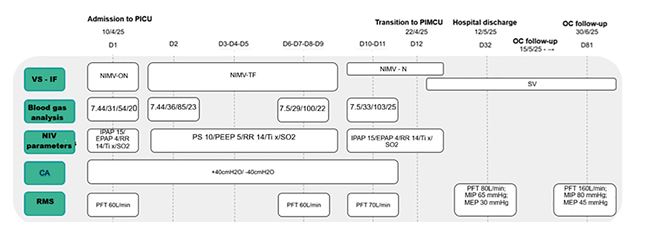
Case description: A 6-year-old male patient presented with ocular pain, diplopia, ataxia and progressive muscle weakness, initially affecting the lower limbs and subsequently involving the upper limbs. He had a prior episode of gastroenteritis one week before symptom onset, along with specific anti-ganglioside antibodies. The medical team diagnosed an atypical presentation of Guillain-Barré syndrome, characterized by rapid progression of clinical symptoms and an unusual pattern of neurological involvement. Due to baseline hypoventilation on auscultation with preserved radiographic lung volumes, along with hypophonia and weak cough (peak cough flow 60 L/min), although with proper airway protection evidenced by effective swallowing of saliva and secretions, non-invasive mechanical ventilation via an oronasal interface without supplemental oxygen was initiated. Additionally, lung volume recruitment and mechanical insufflation-exsufflation were performed. On day 32, the patient was discharged from the hospital, breathing spontaneously on room air.
Conclusion: This case reports a patient with Guillain-Barré syndrome who, while main taining adequate functional airway protection, received early Non-Invasive Mechanical Ventilation. This intervention, combined with lung volume recruitment and mechanical insufflation-exsufflation strategies, allowed treat of ventilatory failure, avoidance of invasive mechanical ventilation, and contributed to a favorable clinical outcome