INTERSTITIAL LUNG DISEASE ASSOCIATED WITH IDIOPATHIC INFLAMMATORY MYOPATHIES.
MULTICENTER STUDY CONDUCTED IN THE PROVINCE OF CÓRDOBA, ARGENTINA
DOI:
https://doi.org/10.56538/ramr.NBKX4553Keywords:
Diffuse interstitial lung disease, Idiopathic inflammatory myopathies, Antisynthetase syndrome, Jo-1 antibodyAbstract
Introduction: Idiopathic inflammatory myopathies (IIMs) are a group of autoimmune
diseases characterized by muscle weakness and extra-muscular manifestations. Diffuse interstitial lung disease (DILD) is a common complication of IIMs, associated with a worse prognosis and higher mortality rates. The objectives of our study were: 1- To describe the clinical, radiological, serological, respiratory functional characteristics, and treatment of patients with DILD associated with IIM. 2- To compare subgroups of IIM
patients with and without DILD.
Materials and Methods: an observational, descriptive, multicenter study was conducted, including patients diagnosed with IIM (with and without associated DILD) between 2017 and 2021 from three centers in the city of Córdoba (Hospital Córdoba, Hospital Italiano, and Sanatorio Allende).
Results: the study included a total of 47 patients with IIM, with a mean age of 44.7 years;
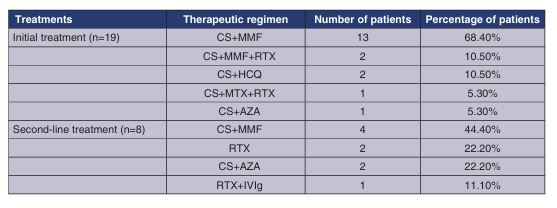
74.5 % of them were female. DILD was present in 55.3% of patients, most frequently in association with antisynthetase syndrome (46.2%). The Jo-1 antibody was the most prevalent (38.5%), and the most common CT pattern was NSIP (non-specific interstitial pneumonia) (57.79%). The mean baseline FVC (forced vital capacity) was 62.2% of predicted, the mean DLCO (diffusing capacity of the lungs for carbon monoxide) was 52.5%, and 50% of patients showed a drop in oxygen saturation during the six-minute walk test (6MWT). The most frequently used initial treatment regimen was systemic corticosteroids combined with mycophenolate (68%). In refractory cases, Rituximab was administered. When comparing subgroups, patients with DILD showed a higher prevalence of antisynthetase syndrome and respiratory symptoms, whereas those
without DILD had more pronounced muscle involvement and ANA-positive antibodies.
Conclusions: in our study of patients with IIM-associated DILD, there was a predominance of middle-aged women, with an autoimmune profile of anti-Jo-1 positivity and an NSIP CT pattern. The treatments used in these patients proved to be effective and safe