Alpha-1 Antitrypsin Deficiency with Pulmonary Nodules and Cirrhosis: a Case Report
DOI:
https://doi.org/10.56538/ramr.PSEI8975Keywords:
alpha-1 antitrypsin deficiency, Pi*ZZ, pulmonary nodules, high-resolution computed tomography, cirrhosisAbstract
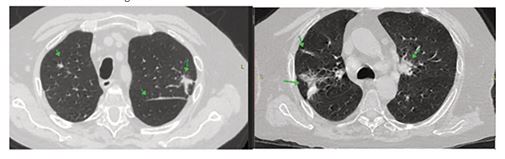
Alpha-1 antitrypsin deficiency (AATD) is an underdiagnosed codominant genetic disorder. The PiZZ phenotype represents the most common form of severe deficiency and is associated with pulmonary and hepatic involvement. In addition to the classic emphysematous phenotype, nodular findings have been described on high-resolution computed tomography (HRCT). We present the case of a 62-year-old nonsmoking man with persistent dry cough and mild dyspnea, in whom the HRCT revealed a dominant solid nodular lesion measuring 24 × 17 mm in the right upper lobe, accompanied by multiple irregular solid nodular opacities of chronic evolution. Abdominal imaging suggested chronic liver disease with normal liver panel and platelet count. Serum alpha-1 antitrypsin level was 69 mg/dL, and the PiZZ phenotype was confirmed. Liver biopsy showed PAS-positive and PAS-D-positive intracytoplasmic inclusions, consistent with alpha-1 antitrypsin polymer accumulation and cirrhosis in the setting of AATD. Granulomatous, infectious, and neoplastic differential diagnoses were conside
red; available bronchoscopic, cytological and microbiological studies did not show active infection or malignancy, and radiological surveillance was adopted due to lesion stability. Phenotypic confirmation enabled a definitive syndromic diagnosis, identified pulmonary and hepatic involvement, and guided targeted management according to international recommendations.