CHARACTERISTICS OF METABOLIC SYNDROME IN A RURAL HIGH-ALTITUDE POPULATION OF PERU
DOI:
https://doi.org/10.56538/ramr.VISU5638Keywords:
metabolic syndrome;, risk factors, altitude, epidemiology, PerúAbstract
Background: Metabolic syndrome represents a major global public health concern, and its prevalence and risk factors can vary significantly in high-altitude populations due to unique physiological adaptations and sociocultural contexts. Evidence on this condition in isolated rural Andean communities remains limited.
Objectives: To determine the risk factors associated with the presence of metabolic syndrome in adults attending outpatient consultation in Acobamba, a high-altitude region in Peru.
Material and methods: A cross-sectional analytical study was conducted on 176 adults (mean age 52,5 ± 13,8 years; 60,2% women) between January and June 2025. Metabolic syndrome was defined according to adapted NCEP-ATP III criteria. Sociodemographic, anthropometric, clinical, laboratory, and lifestyle data were collected. Descriptive, bivariate, and multiple logistic regression analyses were applied to calculate adjusted Odds Ratios with 95% confidence intervals.
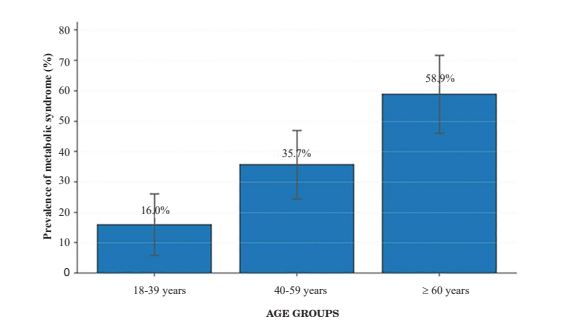
Results: The prevalence of metabolic syndrome was 37,5% (30,3-45,1). Independently associated factors included age (1,68 per decade; 1,25-2,26), low educational level (2,15; 1,02-4,53), obesity (body mass index ≥30 kg/m2; 2,78; 1,35-5,72), and low physical activity (1,99; 1,01-3,93).
Conclusions: Significant modifiable and non-modifiable risk factors associated with metabolic syndrome were identified in this Andean high-altitude population, underscoring the need for culturally adapted preventive and clinical management interventions focused on these determinants.